
American Fathers 4Change with a mission of helping to bring awareness that by increasing the proportion of children growing up with involved, responsible, and committed fathers it will improve the well being of children.
Showing posts with label Parental alienation syndrome. Show all posts
Showing posts with label Parental alienation syndrome. Show all posts
Thursday


Displaced fathers are overwrought at the loss of contact with their children
Dr. Edward Kruk: 'Is Sole Custody
A Form Of Parental Alienation?'
Here's Barbara Kay again with her usual lucid, fact-based piece (National Post, 6/15/11). In it she raises a number of good points, one of which I should have raised earlier myself. I'm delinquent for not having done so and will duly fall on my sword at the appropriate moment. That point is simple; over the past, say, 20 years, fathers have taken on more and more of the care of their children. That's reflected in statistics and it's also reflected in popular culture where we see movies, commercials, sitcoms, novels, etc. about fathers and children or at least involving them in significant roles.


But courts remain firmly stuck in the past; the overwhelming majority of child custody still goes either solely or primarily to mothers. What that means is that children and fathers suffer as never before when parents divorce. In the past, dad may have seen his role as exclusively the breadwinner and therefore taken little part in day-to-day childrearing. In the event of divorce, it could be argued that separating him from his child wouldn't be too traumatic for either. After all, their relationship was a bit distant anyway. I would object to that argument, but now, with fathers bonding ever more closely to children, consigning him to the role of paying visitor is doubly bad policy. It's an important point and one I'll come back to in the future, partly because the always excellent Dr. Edward Kruk makes it in his new book, to which Kay refers.
Tuesday
Parental Alienation and Lies...Evidence Ignored by Family Court Judges


ParentalAlienationAwareness

167 Red Flags or Examples of Parental Alienation
Father? What Father?
 Parental Alienation and Its Effect on Children

By Chaim Steinberger
Part One Preface
“[A] twelve-year study commissioned by the Family Law Section of the American Bar Association of over 1,000 divorces found that ‘parental alienation,’ the programming of a child against the other parent, occurs regularly, sixty percent (60%) of the time, and sporadically another twenty percent.”

There is no doubt that every child needs “frequent and regular” contact with both parents to develop in a psychologically healthy manner.2 A custodial parent is, therefore, obligated by law to ensure the continued relationship between the child and the non-custodial parent.3 The Appellate Division, Second Department, explained why frequent contact is needed between them: Only [with frequent contact] may a non-custodial parent provide his child with the guidance and counsel youngsters require in their formative years. Only then may he be an available source of comfort and solace in times of his child’s need. Only then may he share in the joy of watching his offspring grow to maturity and adulthood. . . .

Indeed, so jealously do the courts guard the relationship between a non-custodial parent and his child that any interference with it by the custodial parent has been said to be “an act so inconsistent with the best interests of the children as to, per se, raise a strong probability that the [offending party] is unfit to act as custodial parent.” . . . The decision to bear children, [moreover], entails serious obligations and among them is the duty to protect the child’s relationship with both parents even in the event of a divorce. Hence, a custodial parent may be properly called upon to make certain sacrifices to ensure the right of the child to the benefits of visitation with the noncustodial parent. The search, therefore, is for a reasonable accommodation of the rights and needs of all concerned, with appropriate consideration given to the good faith of the parties in respecting each other’s parental rights.4

Nevertheless, a twelve-year study commissioned by the Family Law Section of the American Bar Association of over 1,000 divorces found that “parental alienation,” the programming of a child against the other parent, occurs regularly, sixty percent (60%) of the time, and sporadically another twenty percent.5 New York courts have in the past “zealously protected” the non-custodial parent’s visitation rights against interference by the custodial parent.6 Custodial parents seeking to exclude the other parent have, therefore, taken to socially and psychologically turning the child away from the other parent so that the child, and not the custodial parent, refuses the visitation.

This type of “alienation” has been characterized by the Second Department as a “subtle and insidious” form of visitation interference that may cause even “greater and more permanent damage to the emotional psyche of a child” than the garden variety visitation interference.7 This article will summarize the leading literature in the field of alienation. Part One will review the different techniques employed by alienating parents to marginalize and exclude the other parent from their children’s lives. It will set out the most common symptoms of alienation so that the reader will be more attuned to recognize and deal with potential alienation, and counsel clients who are effected by it.

Finally, it will describe the profound and enduring devastating psychological, emotional and social consequences alienation has on its primary victims—the children. Part Two of the article will appear in a subsequent issue and describe the effective treatments for alienation, and how New York courts have traditionally and recently dealt with the issue. Because alienation has such profound inter-generational consequences, judges and lawyers must be ever-vigilant to detect and deal with alienation, no matter the guise by which it is concealed. 10 NYSBA Family Law Review | Spring 2006 | Vol. 38 | No. 1

Friday
Father sued the mother in civil court for “malicious prosecution” and received an award of $3.5 million damages.

CASE STUDIES OF PAS IN COURT
Compiled by DV LEAP, Joan Meier, Director, and Andrew Hudson (intern) for consideration by the Committee on the DSM-VThe following brief compilation includes cases that DV LEAP is aware of, either through its own litigation, that of colleagues, and/or press accounts. Where there are published appellate opinions, cases are cited instead in the accompanying memorandum overview of all published cases referencing PAS as of 2009. A very few cases are cited in both this memorandum and the accompanying one.

1) O. v. O. (Ark. 2008)
In a divorce action, the husband admitted to physically abusing the wife on two occasions, and the trial court credited the wife’s account of a third incident, but found that it did not reach the level of domestic violence. The oldest child and to a lesser extent the younger child reported abusive incidents by the father, and fear of the father, to their therapist, who testified. However, a psychiatrist – relied on by the state child protection agency - testified that the mother’s and children’s allegations of physical abuse were nothing more than Parental Alienation Syndrome. On this basis, as well as the trial court’s finding that the three known incidents did not constitute a “pattern,” as required by statute, the court denied a PO.
The court subsequently awarded sole physical custody of the children to the husband, again influenced largely by the PAS evaluator. The psychiatrist testified that the mother would, if given the opportunity, spread the “condition” to the other children as well.
After the trial court’s order was entered, the father was arrested at gun-point and charged with child endangerment after he fled the scene of an auto accident he caused, leading police on a high-speed chase with the three boys in the truck. Despite this and another incident necessitating temporary removal of the children from the father, neither DHS nor the court would return custody to the mother, and the father retains custody. Both the PO and the custody case are on appeal.
www.dvleap.org
2) B v. D (2001-2007)
Mother and father had never lived together, and father was threatening and abusive toward the mother. On returning from a visit at her father’s the daughter (then 5) told her mother that the child’s father had touched her vagina with his fingers for “a long time.” After being advised by the counselor who had been working with the child to report to DCF, DCF advised her to call the police and pediatrician. The police commenced their own investigation which included an interview of the team by the State’s abuse team coordinator, employed by the Yale-New Haven Child Abuse and Sex Abuse Clinic. The child reported several other sexual touchings to this evaluator, who found her statements credible. The Yale Clinic found that the child had been sexually abused. DCF’s social worker also reported a credible disclosure by the child.
The father was criminally prosecuted but the case resulted in a hung jury. The child refused to testify again so re-prosecution was not possible. In the meantime the Family Court concluded that the father had not abused the daughter, in large part due to the opinions of several evaluators who opined that the mother and daughter were afflicted by Parental Alienation Syndrome. They claimed that the mother fervently believed that her daughter was molested, and had convinced her daughter that she was, but she wasn’t. At least one of these “diagnoses” was provided without any contact with the child.
The father then sued the mother in civil court for “malicious prosecution” and received an award of $3.5 million damages, which was upheld despite a vigorous and well-conducted appeal. The father has since terminated his parental rights; the mother is sole provider for the child, and is forced to pay the father a weekly deduction from her meager paycheck. (The father is now suing the state agencies that believed the child; he also unsuccessfully sued one of the judges.)

Monday
Children should have access to ALL their family

Family Access-Fighting for Children's Rights
ATTENTION ALIENATED FAMILY MEMBERS!!!
"THE ROLES OF EXPERTS IN PARENTAL ALIENATION CASES"
Saturday, June 4th is the last day for new callers to register for our international support call seminar with Dr. Bob Evans. Regular callers have until Sunday, June 5th at 6 PM EDT to register. These are firm deadlines! To register, please email familyaccessinnc@aol.com.
Trying to understand all of this can be difficult at best. There are also many significant issues surrounding custody evaluations in parental alienation cases as well. And let us not forget the grandparents dealing with these issues too.
Our June call will focus much on these issues as well as your questions that you submitted and Dr. Evans is now looking over.
We are extremely fortunate to have the leading experts in the world on alienation to do these seminar calls for us at no charge to us. This is a wonderful opportunity for all of us to glean from them and help us and our families. Please take advantage of these calls. They are a tremendous help.
The calls are now set up for all countries to participate. We have a local number for all countries except Canada. Canada uses the US number and info. We also Skype our calls as well. Looking forward to you joining us.
Source: "THE ROLES OF EXPERTS IN PARENTAL ALIENATION CASES" ~ Children's Right Facebook Support Group
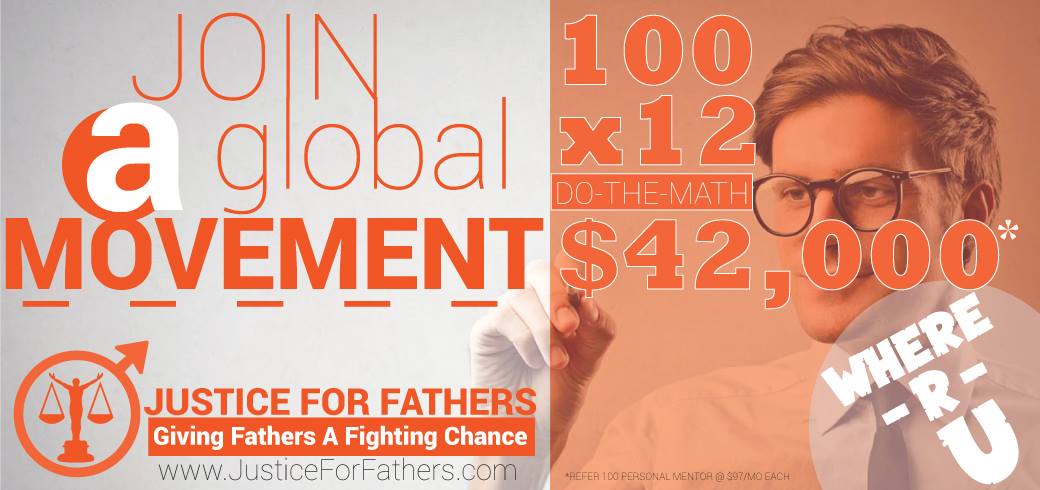 I need 10 Beta Testers. We are Justice for Fathers - and we have a new community that we plan on launching for Fathers Day 2016. Our goal is to reward all Members so that they can pay their child support and or other expenses. Justice For Fathers dies not bash Mothers. We are here to find a cure for Parental Alienation Syndrome - a form of child abuse. Join our Community as a Personal Mentor and start earning Big. As a gift, use the coupon code: DO THE MATH at checkout to get started for only $35. You must agree to refer 10 other paid members at any level. Join us at: www.justiceforfathers.com/join
Thursday
Healing for Target Parents...Are you willing?



 In my YouTube video, Parental Alienation Syndrome Excerpts from Gregory Mantell Show, I have excerpted segments from an excellent discussion of Parental Alienation. This episode is from a weekly half-hour progam, the most successful talk show on the internet. “The Gregory Mantell Show” also airs on cable TV in Los Angeles and NYC. The episode’s discussion is comprehensive and features Dr. Jayne Major and police officer Catherine MacWillie. I have excerpted approximately 6 min from this 26 min segment. The excerpts will speak for themselves with one comment that I reserve at the end.
Dr. Major emphasizes that the obsessed alienator is consumed with destroying the targeted parent’s relationship with the child. She concludes that the severely obsessed alienator is untreatable. Her comments include “They don’t bend;” ”It is winner take all for them;” “They have a very serious psychiatric problem.” “You can’t fix those people.”


 My experience corroborates her conclusion that severely obsessed alienators are untreatable, often sociopathic and narcissistic, unable to experience empathy or compassion for others, and unable to appreciate another person’s point of view, including that of their child. They feel entitled to destroy the targeted parent and as collateral damage, even harm their children.
But Dr. Major – and many others – come to a common conclusion which I question. She and others conclude that obsessed alienators continue to spin elaborate falsehoods to the point that they actually come to believe their own fabrications.
We cannot read their minds. We cannot know what they actually believe. They lie. When a rapist, for example, elaborates a detailed, vivid account of his innocence, does that mean he really believes he wasn’t at the scene of the crime, or is he just spinning a convincing version of what he wants others to believe? If – as I think –parental alienators are sociopathic without conscience – how can anyone know the difference between what they actually think and what they say? Parental alienators lie about the targeted parent. They can be very convincing. They can even induce others to conclude that they actually believe their own fabrications.

I will relate a brief clinical vignette. Joe, not his real name, was convicted of spousal abuse and remanded by the court to a rehabilitation program for abusers. As part of the therapy, staff and patients participated in a dramatization about physical abuse between a husband and wife. A male staff member played the part of the abusive husband. When his stage wife complained that he had punched and hurt her, he apologized. Joe immediately stood up and instructed the stage husband, “Never, never apologize; never admit your responsibility.” I think Joe reveals something important. He is telling us that, as an abuser, he would not acknowledge his abusive behavior. That does not mean he lacks awareness of it – only that he would never acknowledge it.

Abusers lie. If they are consistent and convincing, they may induce others to believe what they fabricate. And, if they are consistently good at it, they may even appear to believe what say. Perhaps, – they have awareness that they are lying, but, perhaps, they never admit it.


The Child’s Participation in Parental Alienation

In divorce, how could a child be brainwashed or programmed by one parent to denigrate the other parent to the point, sometimes of outrageously vilifying and hating the targeted parent.
 Forensic psychiatrist Dr. Richard A. Gardner first identified Parental Alienation Syndrome (PAS) in the 1980’s. He observed that the disorder wasn’t just brainwashing or programming by a parent. It includes what Dr. Gardner calls self-created contributions by the child in support of the alienating parent’s campaign of denigration against the targeted parent.
Excerpted from: Gardner, R.A. (1998). The Parental Alienation Syndrome, Second Edition, Cresskill, NJ: Creative Therapeutics, Inc.
The child’s part in PAS
Gardner emphasizes that in PAS both the parent and the child contribute to the denigration of the targeted parent. The child has to actually participate in the process.

- The child denigrates the alienated parent with foul language and severe oppositional behavior.
- The child offers weak, absurd, or frivolous reasons for his or her anger.
- The child is sure of him or herself and doesn’t demonstrate ambivalence, i.e. love and hate for the alienated parent, only hate.
- The child asserts that he or she alone came up with ideas of denigration. He calls this the “independent-thinker” phenomenon in which the child asserts that no one told him to reject and vilify the targeted parent.
- The child supports and feels a need to protect the alienating parent.
- The child does not demonstrate guilt over cruelty towards the alienated parent.
- The child uses borrowed scenarios, or vividly describes situations that he or she could not have experienced.
- Animosity is spread to the friends and/or extended familyof the alienated parent.

In severe cases of parent alienation, the alienator can even truthfully say that the child doesn’t want to spend any time with this parent, even though he or she has told the child that visitation is ordered by the court. The alienator can say, “There isn’t anything that I can do about it. I’m not telling him that he can’t see you.”


The Escalating Levels of Parental Alienation (PA)
PAS has not developed if the child still has a positive relationship with the targeted parent, even though the other parent is attempting to alienate. This level of alienation may be called Parental Alienation (PA) but, without the child’s denigrating the targeted parent, it falls short of the full Parental Alienation Syndrome (PAS).


Dr. Douglas Darnall in his book Divorce Casualties: Protecting Your Children from Parental Alienation describes three categories of PA:
Mild alienators are willing to be educated and change.


Moderate alienators more aggressively alienate. They get out of control and don’t want to admit it when they were.

Severe alienators are obsessed with absolutely destroying the other parent’s relationship with the child. Severe alienators are untreatable. They are sociopaths without guilt or conscience about destroying the other parent. Dr. Gardner believes the only effective management of obsessed alienators is removing the child from their influence.
 The courts have difficulty with PAS because traditional child abuse on the part of the alienating parent is unclear, especially when the child may be otherwise well cared for. On the other hand, PAS involves no true parental abuse and/or neglect on the part of the targeted, alienated parent. The child’s animosity is not justified.
When parents first separate there is often parent alienation. A parent, for example, might communicate indirectly to a child the message that he or she is not safe with the other parent.

The alienating parent might say:
“If you get scared, you call me right away.”
“I’ll come get you if you want to come home.”

Usually this level of alienation subsides as the parents adjust.
What motivates a parent to undertake PAS?
 PAS parents tend to be narcissistic (self-centered) and sociopathic (lacking moral conscience). They experience a significant narcissistic blow from the failure of the marriage, and they feel entitled to absolutely destroy the child’s relationship with the other parent. To accomplish this, they must essentially assume total control over their child. They may appear to love their children, but this is only an appearance. To the alienator, the children are merely possessions – much like a “beloved” teddy bear is. If “Teddy” were to come to life and actually assert himself, the alienator might toss him into the closet. Alienators are unable to see the child as a separate from themselves. Possession is not real love. Truly loving parents don’t need to do a parentectomy on their child (assuming no actual abuse has taking place). But alienators feel entitled to lie.
Narcissistic alienating parents presume that they have special entitlement. They think that rules apply only to other people.
 As sociopaths, they are unable to experience empathy or compassion for others. They are unable to appreciate another person’s point of view, including that of their child.
In spite of admonitions from judges and mental health professionals to stop their alienation, they can’t. The prognosis for severely alienating parents is very poor. It is unlikely that they will stop trying to perpetuate the alienation. It is virtually a survival issue to them.


Gardner observed that alienation is not the full syndrome unless the child actively participates in the alienation and denigration of the targeted parent. The targeted parent, however, struggles to understand what has happened to what was once an affectionate and loving child who is now inexplicably hostile. How does this happen?


A central role of parenting is to help the child grow into a separate, independent person. Instead of promoting independence, however, the alienating parent exploits and encourages continued dependence. The alienating parent projects an image of himself or herself as capable and of the targeted parent as incapable of caring for the child.


When children enjoy spending time with the targeted parent, they learn that such information is not welcome to the alienator. They may want to bond with the targeted parent, but they essentially make a strategic decision that it is in their best interests to side with the powerful alienator. Therefore, children will tell the alienator everything they didn’t enjoy about time spent with the other parent.


The targeted parent may have indeed spanked the child or lashed out at the alienating parent physically or emotionally. But an isolated incident can be remembered as a massacre.


The alienating parent’s hatred exceeds normal bounds of resentment and can include allegations of domestic violence, stalking ,and the sexual molestation of the child. Targeted parents have been unnecessarily subjected to investigations of child abuse and neglect. In most cases the investigators report they found nothing wrong.

The lying befuddles most alienated parents. Yet, alienating parents are not necessarily unaware that they are fabricating. But they are consistent and convincing. They feel entitled to lie to gain their ends.
Almost always the alienator has people who support the alienation. The alienating parent often successfully enlists surrogate alienators, such as friends, lawyers, teachers, doctors, and mental health specialists who believe the alienator’s stories of how horrible is the other parent.


Family members may also support the alienator financially or even provide massive amounts of money to fund litigation.
Alienation progresses by the alienating parent telling the child in great detail about every miserable and negative experience with the targeted parent. The child, enmeshed with the parent, absorbs the parent’s negativity. The child aligns with this parent and feels a need to protect the alienating parent. The alienating influence on the child is often further compounded by the presence of surrogate alienators.


What happens to the PAS child?

Obsessed alienators are untreatable. They are sociopathic, lacking moral conscience about the damage they inflict on the targeted parent and upon the children they would like everyone to believe they love. Dr. Gardner believes the only effective management of obsessed alienators is removing the child from their influence.


If the full syndrome is allowed to develop, the child becomes estranged from the alienated parent. The relationship with this parent is ultimately severed. Even as an adult, the child may never understand what happened.
The child’s primary role model will be the maladaptive, dysfunctional parent. He or she will not have the benefit of growing up with the more well-adjusted parent and all that this parent can contribute to enrich the child’s life. Many of these children come to experience serious psychiatric problems.


Without someone who can recognize the syndrome and counsel them, it is unlikely that they will ever understand it. However, sometimes, the child and the alienated parent do successfully reunite later in life.


As an aid in understanding this difficult to comprehend and fascinating phenomenon, you may view my YouTube videos on the topic by visiting my website at http://www.LesLinetMD.com

Parental Alienation is either a form of Domestic Violence or on the continuum of Domestic Violence behaviors.

Subscribe to:
Posts (Atom)
Why say NO to attorneys in the Legislature?

THE LARGEST CLASS ACTION IN HISTORY
Freedom of speech in the United States

Congress shall make no law...