American Fathers 4Change with a mission of helping to bring awareness that by increasing the proportion of children growing up with involved, responsible, and committed fathers it will improve the well being of children.
"The man as he converses is the lover; silent, he is the husband." ~ Honore de Balzac
Those were the cruel words my father-in-law, Dr. Little, heard when he was a young man at a public golf course in 1959.
“Good,” he responded. “Because money is green.”
He left his cash on the counter, turned around, and walked out the door to go play a round of golf.
Later, he and his friends were escorted away by police for playing on a “whites only” course. Rather than exploding into a violent rage, as many others would have done, Dr. Little stayed calm and held his head high during his arrest.
That highly publicized event and his example of a dignified man were instrumental in the future of the golf course, which would be integrated a few years later.
On MLK Day, I find myself reflecting on my father-in-law’s story. I am also reminded that Dr. King’s famous “I have a dream” speech was about being a father. It was about envisioning the future he wanted for his children, and then working to make that dream a reality.
“I have a dream that my four little children will one day live in a nation where they will not be judged by the color of their skin but by the content of their character,” he said.
Where Fathers, Mothers, GRANDparents and Children from all 50 states will be uniting at their State Capitols to demand a change in Family law. This is an EQUAL RIGHTS issue and OUR Children need, want and deserve to have BOTH fit parents as active participants in their lives. Those states participating are as follows: Alabama Alaska Arizona Arkansas California Colorado Connecticut Delaware Florida Georgia Hawaii Idaho Illinois Indiana Iowa Kansas Kentucky Louisiana Maine Maryland Massachusetts Michigan Minnesota Mississippi Missouri Montana Nebraska Nevada New Hampshire New Jersey New Mexico New York North Carolina North Dakota Ohio Oklahoma Oregon Pennsylvania Rhode Island South Carolina South Dakota Tennessee Texas Utah Vermont Virginia Washington West Virginia Wisconsin Wyoming
Problem 1: Children who lose contact with their fathers do worse in life.
Problem 2: Single mothers who want to work often struggle with the cost of childcare.
Problem 3: Many non-resident fathers are without meaningful work.
All three of these problems are fairly well established in the research literature. Each also motivates a battery of policy responses, with varying degrees of efficacy. In a recent report on poverty and opportunity from a working group convened by Brookings and the American Enterprise Institute, non-resident fathers received some special attention. (I was a member of the group).
The report notes that the Child Support Enforcement Program has become increasingly effective at establishing paternity and levying child support payments. Good: parenting is a responsibility, regardless of the nature of the relationship into which a child is born. But the payments can also be onerous for non-resident parents, who are almost always fathers, ‘functioning as a tax on their earnings’. The accumulation of child support debt is a particular problem – non-resident parents are currently about $53 billion in arrears for child support – and the Brookings/AEI group suggested that these kinds of debts should be forgiven in certain circumstances.
“Failing to expect both parents to support their children is not only unfair, it reduces marriage incentives, increases poverty rates for custodial mothers and children, and is likely to hurt children,” the report concludes. But we should not make the mistake of assuming that support can only come in the form of cash.
Since most non-resident parents are fathers, there is a tendency for policy-makers to see them primarily in terms of their financial obligations, as walking ATMs. Many of these men are in no position to make serious financial contributions: 41 percent of poor non-resident fathers have been out of paid work for at least a year, according to a recent study conducted by the Urban Institute. Meanwhile, working single mothers are also struggling. Forty percent of those working said that child care costs led them to change jobs or hours worked, according to a recent survey.
So, let’s see…Lots of non-resident fathers are not gainfully employed; single mothers are struggling with childcare cost; and children, especially boys, are suffering from the distance or absence of their father. Here’s an idea: have the fathers look after their children, allowing mothers to get into and stay in work. The savings for the mother would far outweigh child support payments, which could be suspended when the father is providing childcare. What if, rather than squeezing these men for every last nickel, we were to ask them to do childcare instead?
How many fathers could help in this way? According to the National Survey of Family Growth, for the years 2006-2010, there were almost nine million non-resident fathers in the United States. We do not know for sure how many of them are not currently in paid work, but we can produce some estimates. As a group, non-resident fathers are less educated than the norm: 15 percent dropped out of high school and 38 percent have just a high school diploma. Given this educational breakdown, and assuming that non-resident fathers, on average, face the same labor market conditions as their similarly-educated peers, we estimate that 2.35 million non-resident fathers are unemployed. This figure lines up reasonably well with the Urban Institute study referred to earlier.
On paper at least, then, there is a potential reserve army of childcare workers of more than two million. Of course there are lots of reasons why this figure does not translate to the real world. Non-resident fathers are more likely to be incarcerated; they may have addiction or substance abuse problems; and they may be wholly unsuited, in some way, for caring for their own children. Some may not live close-by. But even so, there must be many fathers who could be doing more care. Many of these men might object to doing the unpaid work of raising their children, even if their child support payments were waived. But if they are not active in the labor market, it is hard to see why they ought to take this view: we are talking about their own children, after all.
Right now, the childcare contribution of non-resident fathers is very low, accounting for just 6 percent of total time when the mother is in a single-parent household, and just 1 percent of total time when the mothers is living with a boyfriend, according to research by Ariel Kalil, from the University of Chicago.
No doubt there are practical obstacles to increasing the amount of care provided by non-resident fathers, including some of those discussed above. But perhaps the greatest barrier is the outdated mental model with which these problems are addressed. As my colleague Isabel Sawhill and I argued in a recent New York Times piece (‘Men’s Lib!’), we urgently need to break down outdated gender roles if both men and women are to flourish. Seeing non-resident fathers as potential caregivers is one step in this direction. After all, women can now serve in every role in the U.S. military, so why can’t we start to see men performing a bigger role as parents?
Richard V. Reeves is Policy Director of the Center on Children and Families at the Brookings Institution.
America leads the industrialized world in fatherlessness.
Right now, around 41 percent of children are born to single mothers.
For women under 30, who bear two-thirds of all children, that rate is 53 percent.
Many unmarried women are cohabiting with partners at the outset of their children’s births, but those couplings disintegrate at twice the rate of marriages.
In total, about one-third of all children are raised in father-absent homes. By some estimates, this means more kids are growing up with televisions in their bedroom than with both of their biological parents. Boys are especially affected by this trend. Without positive and consistent male role models, society misses out on much of their constructive potential. It’s no coincidence 70 percent of male inmates did not grow up with both parents, for example.
Even for those with fathers, the average school-age boy spends just half an hour per week in one-on-one conversation with his father, according to David Walsh, founder of Mind Positive Parenting.
“That compares with 44 hours a week in front of a television, video game screen, [and] Internet screen,” he says. “I think that we are neglecting our boys tremendously. The result of that is our boys aren’t spending time with mentors, with elders, who can really show them the path, show them the way of how it is that we’re supposed to behave as healthy men.”
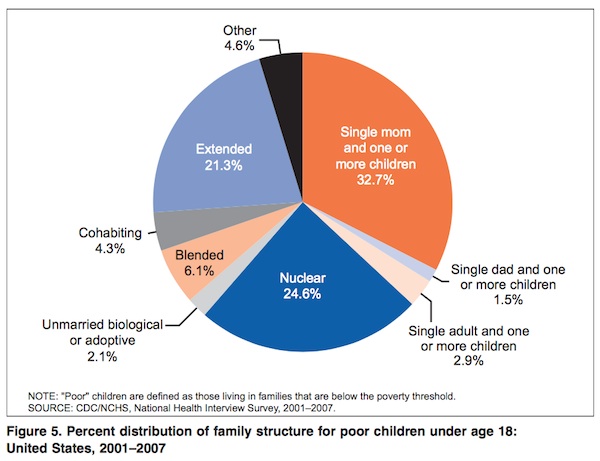
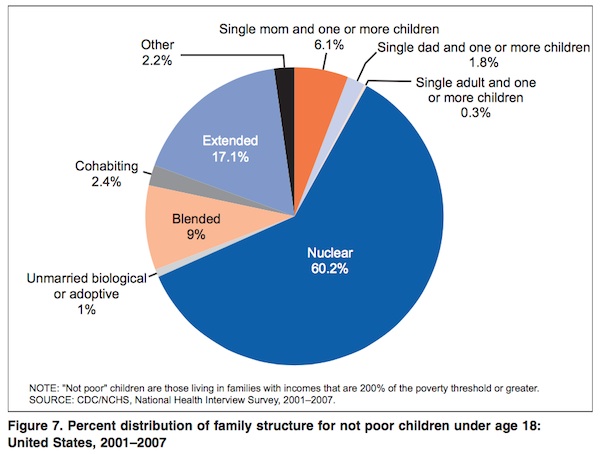
Across the board, children with intact families have more advantages than their fatherless peers. A report published byThe Center for Disease Control and Preventionsays children of married biological parents or adoptive parents are healthier, have fewer definite or severe emotional or behavioral difficulties and are less likely to grow up in poverty. They also have more friends. When Gen-Y children were surveyed in elementary school, those who were living with their fathers scored better on 21 of 27 social competence measures.
The US Is Leading The Way In Fatherlessness And It's Hurting Our Kids
On average, a little over 3 million children in the US receive welfare benefits, known as Temporary Assistance for Needy Families (TANF) or State Supplemental Program (SSP), each month during the fiscal year. A recent report from Pew Research indicated 18 percent of American adults have received assistance from the Supplemental Nutrition Assistance Program (SNAP), or “food stamps,” at some point in their lives, and Democrats were twice as likely as Republicans to have used food stamps. Women were about twice as likely as men, and black people were twice as likely as white people to have received food stamps.
Paramount Pictures
People over 65 years old were the least likely age group to say they had received food stamps, while people with less education – a high school diploma or lower – were three times more likely than college graduates to have received those benefits. Women who marry or maintain a home with the biological father of their children can face the reduction or loss of their benefits, according to the US Department of Health and Human Services:
“Our main finding is that if a male has financial resources, TANF provides the greatest disincentive to form and/or maintain a biological family, and the least disincentive, if not an incentive, to form an unrelated cohabitor family. In a biological family, where the male is the father of all the children, he must be included in the unit and his resources counted. In an unrelated cohabitor family, where he is father of none of the children, he is not included and his resources are not counted. In addition, most states disregard unrelated cohabitor vendor and cash payments to the TANF recipient and her children.”
In other words, the current structure of TANF actually promotes having nearly any man but the biological father heading the house. Women are also about six times likelier to get sole custody of their children after separating from their fathers. In some cases, men even go to jail for falling behind on child support payments. In South Carolina, for example, about one out of seven inmates are imprisoned for this very reason, and 75 percent of them were unemployed or having trouble finding work. How sending them to jail will help them, their families, or taxpayers is a mystery. And. again, for children with fathers, dads are missing out on crucial bonding time. Children who had frequent and positive interactions with their fathers, such as the father paying attention to the child’s interests, offering encouragement and smiling, during the first year of their lives were calmer and better behaved than other children at age two. This was especially true for boys. Involved dads also reduce the chances of their infants experiencing cognitive delays, and fathers themselves feel more confident about their job skills, parenting skills and social relationships. The US is an oddity among Western nations in not granting statutory paid maternity or paternity leave or providing childcare at a reasonable cost. This creates a situation where women are forced to choose between work and family (to “lean in” or “lean out”), while men have no option but to “lean in” or just opt out altogether.
These trends paint a very disconnected picture, but that can change. The government can step up by commissioning a White House Council on Boys and Men. There is currently a White House Council on Girls and Women, but they have yet to support a similar platform for men, even though it has been proposed and endorsed by a number of experts. Creating policies that support a father’s right to be present in his children’s lives during divorce and custody battle situations, eliminating perverse welfare incentives for parents to live apart, offering men paternity leave equal to maternity leave, providing childcare for both mothers and fathers and encouraging family members to visit inmates would also be steps in the right direction. Sponsoring a nationwide male mentorship program to bring more positive male figures into children’s lives would also help reverse these trends.
"So live your life that the fear of death can never enter your heart. Trouble no one about their religion; respect others in their view, and demand that they respect yours. Love your life, perfect your life, beautify all things in your life. Seek to make your life long and its purpose in the service of your people. Prepare a noble death song for the day when you go over the great divide. Always give a word or a sign of salute when meeting or passing a friend, even a stranger, when in a lonely place. Show respect to all people and grovel to none. When you arise in the morning give thanks for the food and for the joy of living. If you see no reason for giving thanks, the fault lies only in yourself. Abuse no one and no thing, for abuse turns the wise ones to fools and robs the spirit of its vision. When it comes your time to die, be not like those whose hearts are filled with fear of death, so that when their time comes they weep and pray for a little more time to live their lives over again in a different way. Sing your death song and die like a hero going home." (Tecumseh).
American Fathers Liberation: ALL Men’s Rights are Human Rights. ’nuff said http://bit.ly/1JgMgEm