A mother of twins was applying for public assistance in Passaic County, N.J., when she made the seemingly uncontroversial claim that one man was responsible for her progeny.
The truth, it turns out, was not so simple.
In an unusual ruling in State Superior Court in Passaic County, Judge Sohail Mohammed found that egg and sperm had colluded to create a medical oddity, according to a report in The New Jersey Law Journal on Thursday. The man who the woman said was the father of her twins was deemed responsible for only one.
The other, the ruling revealed, was conceived during a previously undisclosed tryst that happened within a week of sexual intercourse with the man she claimed was the father.
It was a tangled web of love and biology that gave rise to what The Law Journal called a precedent-setting ruling, one of only a few of such cases across the country. The man originally described as the twins’ father, identified in court documents only as A.S., will now have to pay child support only for the toddler who a DNA test showed was reliably his own.
The case took root when the mother, identified only as T.M., told the Passaic County Board of Social Services in the course of applying for benefits that A.S., her romantic partner, had fathered her twins, The Law Journal reported. The board, in turn, filed an application to establish his paternity and force him to pay child support for the twins, born in January 2013.
But the woman’s claim slowly fell apart. She revealed in testimony that she had had sex with a second, unidentified man within a week of having sex with her romantic partner. A paternity test was ordered.
And when the results came back last November, a routine case became a curiosity destined for legal textbooks.
Judge Mohammed accepted the results after testimony from Karl-Hans Wurzinger, the laboratory director of the Identity Testing Division at Laboratory Corporation of America, The Law Journal reported. Dr. Wurzinger, who has published a study saying that one in 13,000 reported paternity cases involved twins with separate fathers, testified that this was one of those rare cases: The woman’s twins were fertilized by different fathers during the same menstrual cycle.
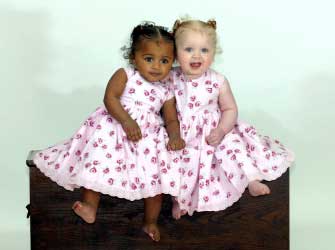
Jennifer Wu, an obstetrician-gynecologist at Lenox Hill Hospital in Manhattan, called it a case of superfecundation, a rare phenomenon classically illustrated in medical textbooks with a black baby and a white baby who are twins.
A sperm can be viable for up to five days, Dr. Wu said. So if the mother in this case had sex with one of the men, ovulated, and then had sex with the other — all within the course of just under a week — one man’s sperm could have fertilized one egg, while the other’s fertilized another.


 Reblogged from The SoCraddock Method:An opinion piece by Brenda Manghane-Washington from the Chattanoogan.comExcerpt:I still believe there's a need of reform in child support laws. As they stand, there is no distinction between a parent who can't pay and a parent who refuses to pay child support. By incarcerating non-custodial parents who do not have the means to pay nothing is accomplished, the children still go without...


HOW DID CHILDREN OF DIVORCE GET STUCK WITH THE VISITATION PLAN THAT AFFORDS THEM ACCESS TO THEIR NON-RESIDENTIAL PARENT ONLY ONE NIGHT DURING THE WEEK AND EVERY OTHER WEEK-END?
ReplyDeleteWhat is the research that supports such a schedule? Where is the data that confirms that such a plan is in the best interest of the child?
Well, reader, you can spend your time from now until eternity researching the literature and YOU WILL NOT DISCOVER ANY SUPPORTING DATA for the typical visitation arrangement with the non-residential parent! The reality is that this arrangement is based solely on custom. And just like the short story, "The Lottery," in which the prizewinner is stoned to death, the message is that deeds and judgments are frequently arrived at based on nothing more than habit, fantasy, prejudice, and yes, on "junk science."
This family therapist upholds the importance of both parents playing an active and substantial role in their children's lives----especially in situations when the parents are apart. In order to support the goal for each parent to provide a meaningfully and considerable involvement in the lives of their children, I affirm that the resolution to custody requires an arrangement for joint legal custody and physical custody that maximizes the time with the non-residential----with the optimal arrangement being 50-50, whenever practical. It is my professional opinion that the customary visitation arrangement for non-residential parents to visit every other weekend and one night during the week is not sufficient to maintain a consequential relationship with their children. Although I have heard matrimonial attorneys, children's attorneys, and judges assert that the child needs the consistency of the same residence, I deem this assumption to be nonsense. I cannot be convinced that the consistency with one's bed trumps consistency with a parent!
Should the reader question how such an arrangement can be judiciously implemented which maximizes the child's time---even in a 50-50 arrangement----with the non-residential parent, I direct the reader to the book, Mom's House, Dads House, by the Isolina Ricci, PhD.
Indeed, the research that we do have supports the serious consequences to children when the father, who is generally the non-residential parent, does not play a meaningful role in lives of his children. The book, Fatherneed, (2000) by Dr. Kyle Pruitt, summarizes the research at Yale University about the importance of fathers to their children. And another post on this page summarizes an extensive list of other research.
Children of divorce or separation of their parents previously had each parent 100% of the time and obviously cannot have the same arrangement subsequent to their parents' separation. But it makes no sense to this family therapist that the result of parental separation is that the child is accorded only 20% time with one parent and 80% with the other. What rational person could possibly justify this?
PRO SE RIGHTS:
ReplyDeleteBrotherhood of Trainmen v. Virginia ex rel. Virginia State Bar, 377 U.S. 1; v. Wainwright, 372 U.S. 335; Argersinger v. Hamlin, Sheriff 407 U.S. 425 ~ Litigants can be assisted by unlicensed laymen during judicial proceedings.
Conley v. Gibson, 355 U.S. 41 at 48 (1957) ~ "Following the simple guide of rule 8(f) that all pleadings shall be so construed as to do substantial justice"... "The federal rules reject the approach that pleading is a game of skill in which one misstep by counsel may be decisive to the outcome and accept the principle that the purpose of pleading is to facilitate a proper decision on the merits." The court also cited Rule 8(f) FRCP, which holds that all pleadings shall be construed to do substantial justice.
Davis v. Wechler, 263 U.S. 22, 24; Stromberb v. California, 283 U.S. 359; NAACP v. Alabama, 375 U.S. 449 ~ "The assertion of federal rights, when plainly and reasonably made, are not to be defeated under the name of local practice."
Elmore v. McCammon (1986) 640 F. Supp. 905 ~ "... the right to file a lawsuit pro se is one of the most important rights under the constitution and laws."
Federal Rules of Civil Procedures, Rule 17, 28 USCA "Next Friend" ~ A next friend is a person who represents someone who is unable to tend to his or her own interest.
Haines v. Kerner, 404 U.S. 519 (1972) ~ "Allegations such as those asserted by petitioner, however inartfully pleaded, are sufficient"... "which we hold to less stringent standards than formal pleadings drafted by lawyers."
Jenkins v. McKeithen, 395 U.S. 411, 421 (1959); Picking v. Pennsylvania R. Co., 151 Fed 2nd 240; Pucket v. Cox, 456 2nd 233 ~ Pro se pleadings are to be considered without regard to technicality; pro se litigants' pleadings are not to be held to the same high standards of perfection as lawyers.
Maty v. Grasselli Chemical Co., 303 U.S. 197 (1938) ~ "Pleadings are intended to serve as a means of arriving at fair and just settlements of controversies between litigants. They should not raise barriers which prevent the achievement of that end. Proper pleading is important, but its importance consists in its effectiveness as a means to accomplish the end of a just judgment."
NAACP v. Button, 371 U.S. 415); United Mineworkers of America v. Gibbs, 383 U.S. 715; and Johnson v. Avery, 89 S. Ct. 747 (1969) ~ Members of groups who are competent nonlawyers can assist other members of the group achieve the goals of the group in court without being charged with "unauthorized practice of law."
Picking v. Pennsylvania Railway, 151 F.2d. 240, Third Circuit Court of Appeals ~ The plaintiff's civil rights pleading was 150 pages and described by a federal judge as "inept". Nevertheless, it was held "Where a plaintiff pleads pro se in a suit for protection of civil rights, the Court should endeavor to construe Plaintiff's Pleadings without regard to technicalities."
Puckett v. Cox, 456 F. 2d 233 (1972) (6th Cir. USCA) ~ It was held that a pro se complaint requires a less stringent reading than one drafted by a lawyer per Justice Black in Conley v. Gibson (see case listed above, Pro Se Rights Section).
Roadway Express v. Pipe, 447 U.S. 752 at 757 (1982) ~ "Due to sloth, inattention or desire to seize tactical advantage, lawyers have long engaged in dilatory practices... the glacial pace of much litigation breeds frustration with the Federal Courts and ultimately, disrespect for the law."
Sherar v. Cullen, 481 F. 2d 946 (1973) ~ "There can be no sanction or penalty imposed upon one because of his exercise of Constitutional Rights."
Schware v. Board of Examiners, United State Reports 353 U.S. pages 238, 239. ~ "The practice of law cannot be licensed by any state/State."
Sims v. Aherns, 271 SW 720 (1925) ~ "The practice of law is an occupation of common right."